

Georgia’s State Security Service says Interior Ministry never purchased Camite chemical agent
Politics
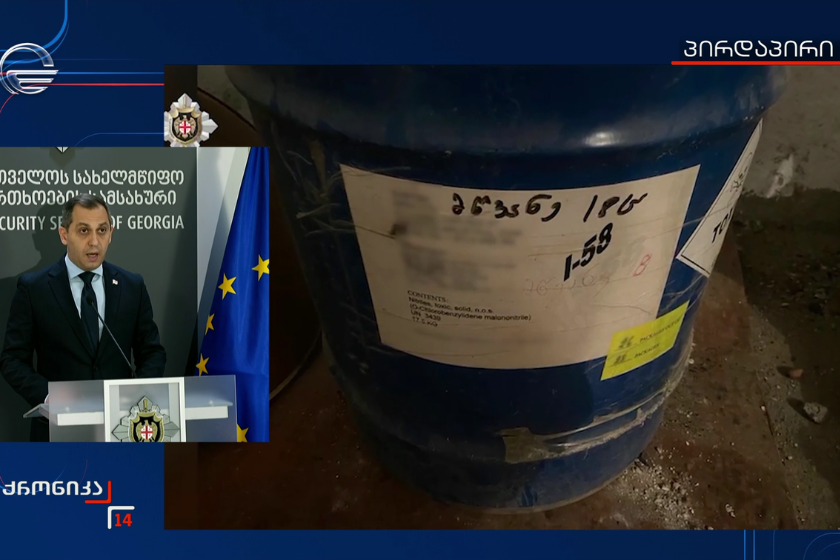
Photo: Imedi TV
Georgia’s State Security Service on Saturday announced that the Ministry of Internal Affairs has never purchased bromobenzyl cyanide, also known as Camite.
The statement comes amid an ongoing investigation into claims aired by the BBC alleging the use of a toxic chemical agent during last year's protests in Tbilisi.
Lasha Maghradze, the First Deputy Head of the State Security Service, noted that during the night of 4-5 December 2024, law enforcement used the substance chlorobenzylidene malononitrile (CS gas) dissolved in propylene glycol for crowd control.
“As you know, for several days now an investigation has been underway at the State Security Service regarding the information presented in the BBC’s report, as well as the campaign carried out in Georgia on the basis of that report”, he said.
“Neither of these substances is classified as prohibited”, the official said.
The Service also reported that all individuals whose assessments or information were referenced by the BBC as evidence of toxic chemical use were questioned as witnesses.
“Every one of them denied that their information or conclusions concerned the chemical agent Camite”, Maghradze said.
The investigation included over 160 investigative actions and interviews with 93 witnesses - current and former Interior Ministry employees, physicians, experts, BBC respondents, NGO representatives, and others.
Investigators collected documentation from the Interior Ministry and the Revenue Service’s Customs Department and seized 25 samples from special-task police units, which were examined by the Levan Samkharauli Forensic Bureau.
According to the investigation, the chemical powder used for years by the Interior Ministry for crowd control is chlorobenzylidene malononitrile (CS gas). Records show it was purchased from an Israeli company in 2007 and 2009, along with the solvent trichloroethylene. The materials were imported under international transport codes UN3439 (CS gas) and UN1710 (trichloroethylene - also used widely in civilian and industrial cargo). A 17.5-kilogram container seized by investigators was labeled with the supplier’s original sticker identifying the substance as CS gas (UN3439).
“The investigation also determined that various Georgian organizations - such as Aversi-Rational, GPC, Rustavi Azot, and others - have imported cargo assigned these same international shipment codes (UN3439 and UN1710) a total of 606 times over the past 20 years, including 507 instances for UN3439 and 99 instances for UN1710. These imports consisted of dozens of different types of civilian, industrial, and medical-use materials, as recorded in customs databases”, he continued.
Maghradze further noted that regarding the substance bromobenzyl cyanide, also known as Camite, such a substance had never been purchased by the Ministry of Internal Affairs of Georgia.
“The individuals whose conclusions or information were used by the BBC as the basis for claims about the use of a toxic chemical agent were questioned as witnesses. All of them denied that their information or conclusions concerned the chemical agent Camite. According to the authors of the so-called study, they could not have determined the use of Camite for the simple reason that they had conducted no research in that area. Representatives from medical and forensic circles were also questioned. Additionally, based on information obtained from open sources, and to address public interest, we clarify that the use of bromobenzyl cyanide, known as Camite, against humans causes severe and, in many cases, fatal outcomes, which is why it was banned in the civilized world in the 1930s”, Maghradze noted.
“In this context, it is notable that according to documents obtained from the Ministry of Health, among the 54 individuals transported to hospitals by emergency medical crews in the days following November 28, 2024, only 5 had mild intoxication, and all were discharged from medical clinics the following day. The investigation also established that during the early days of December 2024 - specifically, on the night of December 4–5 - the substance chlorobenzylidene malononitrile was used for crowd control, dissolved in a propylene glycol solution. Neither substance falls under the category of prohibited materials. [...] The only person of interest whom investigators were unable to question is Lasha Shergelashvili, whose information significantly influenced the opinions of the BBC report’s author. As a result of these operational and investigative actions, it was established that the chemical powder purchased by the Ministry of Internal Affairs of Georgia and used for mass control during various protests over the years, as needed, is chlorobenzylidene malononitrile”, he said.
While the false Camite allegations have been fully examined, the State Security Service continued its investigation under Article 319 of the Georgian Criminal Code, concerning assistance to a foreign organisation in hostile activities.
“Thus, the indisputable evidence obtained during the investigation allows us to conclude that the information voiced in the BBC film about the alleged use of the so-called chemical weapon Camite against protesters in Georgia is entirely false and deliberately misleading. It aims to harm Georgia’s interests and, unfortunately, involves Georgian citizens whose actions, alongside those of the film’s authors, constitute a well-planned, organised, and coordinated campaign against Georgia with specific hostile objectives. Accordingly, since one of the two directions of the investigation - namely, the fabricated allegation that the police used Camite - a substance banned since the 1930s - has been fully examined, the State Security Service continues to investigate the possible crime defined in Article 319 of the Georgian Criminal Code, which concerns assisting a foreign organisation in hostile activities. The State Security Service of Georgia will continue to pay special attention to issues of political stability and security, which remain among the country’s key challenges in the security field”, Maghradze concluded.


