

Georgian First Vice PM: consensus-based energy policy key to success
Economy
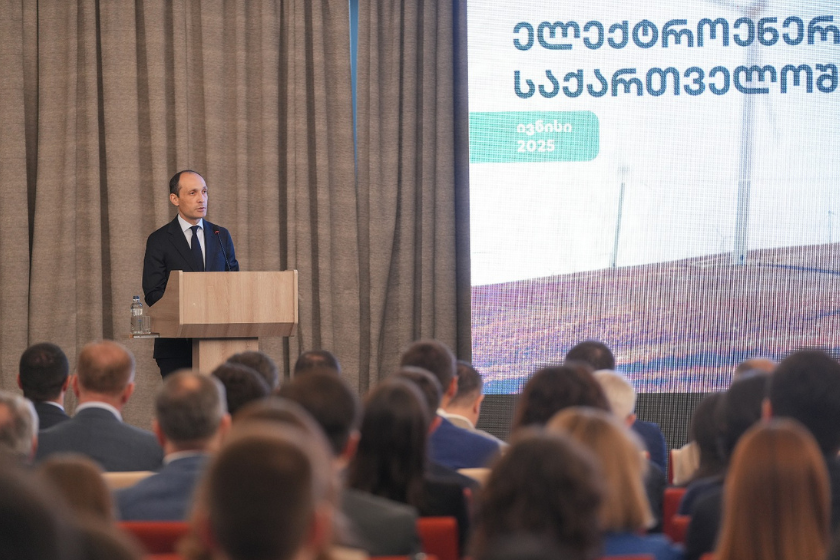
Levan Davitashvili
Photo: Ministry of Economy and Sustainable Development of Georgia
Levan Davitashvili, the First Vice Prime Minister and Minister of Economy and Sustainable Development of Georgia, on Friday stated that an energy policy agreed upon with various parties and based on broad consensus would be successful, and that there was no alternative to it.
In his address at an international conference on financial technologies organised by the National Bank, Davitashvili noted that Georgia had significant potential for electricity generation from renewable energy sources - not to mention hydropower, which is the dominant source in energy generation mix.
“In addition, wind and solar power plants are becoming increasingly popular from an investment perspective, and I believe that compared to neighboring countries, which are trying to become more attractive centers and turn into energy resource trading hubs, our country has even more opportunities and potential - and it’s important that we take advantage of this as well”, Davitashvili said.
He further noted that assessment, the energy sector was crucial for economic development because without its proper development, discussions about the competitiveness of the economy are pointless.
The First Vice Prime Minister emphasized that for the correct, sustainable, and long-term development of the energy sector, it is very important to listen to various parties, reconcile positions, and reflect this in the energy policy, which should be adopted based on broad consensus and has no alternative.
As the minister noted, every successful policy that the country implements is successful only if it is shared by various parties and coordinated with the main stakeholders.
Davitashvili said that in recent years, the main investors in the energy sector have been private local and foreign companies, interest from private investors remains high in the future, and accordingly, a policy shared with them would be the right policy.
Levan Davitashvili highlighted the importance of infrastructure development for the successful development of generation facilities.
In his assessment, development and coordinated actions carried out synchronously were crucial here.
“This coordination needs to be improved in the future, and I believe that with a more coordinated policy, we will be able to develop infrastructure in line with private investors’ investment plans. We also understand that when we talk about the integration of energy facilities from renewable sources, electricity storage infrastructure is very important. In this regard, the Georgian State Electrosystem has an important project – a purchase of 200 megawatt batteries is planned, for which a tender will be announced this year. Funding has been obtained from the Asian Development Bank, preceded by two years of successful research work, and I think this will be an important element that will contribute to system stability”, he continued.
In his speech, Levan Davitashvili also touched on the opportunities arising from Georgia’s geostrategic location to become one of the important nodes for data exchange.
Georgia can be a significant part of the digital corridor connecting Europe and Asia, not only in terms of transportation but also digitally. Levan Davitashvili noted that globally, electricity consumption is increasing due to energy-intensive manufacturing, data centers, artificial intelligence centers, and industrial growth, while sectors such as cement production, chemical industry, and steel production are beginning to use green, renewable energy, which the minister believes will be an even more active direction in the future”, he concluded.
Davitashvili also added that many countries, including the European Union, were imposing new regulations and trade rules so that such sectors largely depend on the use of energy from renewable sources. It was important that Georgia has a very significant potential for electricity generation from renewable energy sources.


