

Parliament Speaker criticises Baltic states, EU bureaucracy over Georgia’s sovereignty
Politics
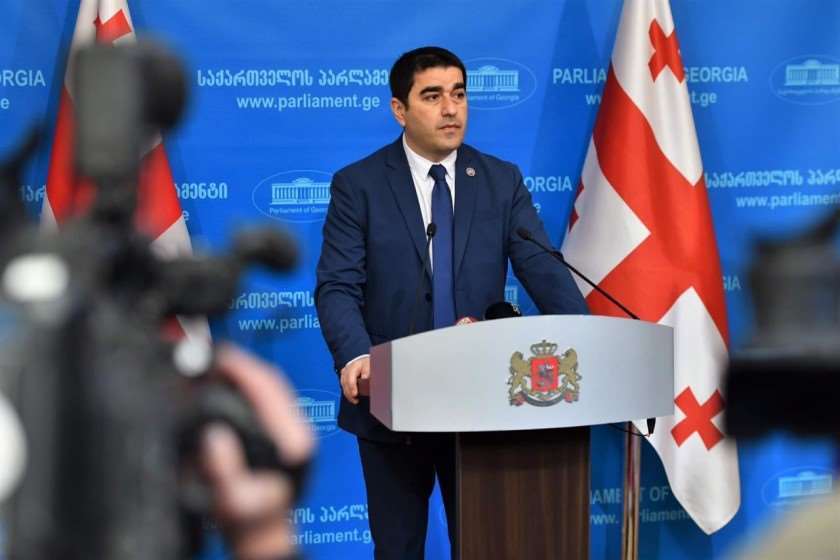
Shalva Papuashvil
Photo: Parliament of Georgia
Georgian Parliament Speaker Shalva Papuashvili on Friday strongly criticised the recent visit of the former President Salome Zourabichvili to the Baltic states, accusing them and European bureaucrats of undermining Georgia’s sovereignty.
In his social media message, Papuashvili outlined three key grievances - a rejection of national sovereignty, the subversion of legitimate authority, and the creation of a misleading geopolitical narrative - all of which, he claimed, echo Soviet-era foreign interference tactics.
“Ex-president Salome Zourabichvili’s last few days’ voyage to the former Soviet Baltic States sums up what is wrong with these countries’, and the European bureaucracy’s, attitude to Georgia, three nasty aspects of which stand out: rejection of national sovereignty, subversion of legitimate authority, and creation of a false parallel universe. All three are reminiscent of what the USSR used to do in foreign affairs”, the Speaker said.
Papuashvili further questioned the credibility of Baltic states’ support for Georgia’s sovereignty, arguing that their recognition of Zourabichvili as a legitimate authority contradicts their stated commitment to respecting Georgia’s territorial and political independence.
“First, we have heard many times that the Baltics “support Georgia’s sovereignty and territorial integrity”. However, as soon as these words meet the real world, they ring hollow. How do these countries support Georgian sovereignty if they ignore the will of the majority of Georgian people to elect their own Government? How does recognising an ex-President, whose term expired last December, as the ‘legitimate authority of Georgia’ square with the talk of ‘supporting Georgia’s sovereignty’? The essence of sovereignty does not change depending on who is recognising or threatening it. For Georgians, it does not make much difference whether the Soviet Union or Lithuania undermines our independent right to form the Government”, he continued.
TWITTER POST
Another major concern raised by Papuashvili was the rhetorical separation of the Georgian people from their Government, a tactic he likened to Soviet-style meddling. He accused Baltic officials of actively trying to delegitimise the Georgian Government while simultaneously hosting Zourabichvili as an official representative. He found it ironic that the same politicians who denounce Soviet and Russian influence would employ similar strategies to interfere in Georgia’s internal affairs.
“In the last few months, we have seen continuous efforts by high-ranking Baltic politicians to virtually, even if fruitlessly, separate the Georgian Government from the Georgian people. Ex-President Zourabishvili’s current voyage to all three Baltic States and her official reception is indicative of the use of the same old Soviet playbook, retrieved, dusted and put to use by the same Baltic politicians who, otherwise, condemn ostensibly anything Communist, Soviet, and Russian. Yet, they seem to have been mentally stuck in the same straitjacket they are so eager to abandon”, the Speaker noted.
Papuashvili also condemned what he described as a fabricated narrative portraying Georgia as a repressive state under Russian influence.
“Estonia, Latvia, and Lithuania tried desperately to increase their own security by trying to distract Russia elsewhere, and thus pushing Georgia towards open confrontation with Moscow after the invasion of Ukraine. By insisting that Georgia, a non-European Union and non-NATO country, impose bilateral sanctions on Russia, they counted on further Georgian-Russian escalation and, in effect, sacrificed Georgia for their own interests. There is no other logical explanation for their policy, because Georgia would not survive an armed conflict with Russia without the NATO security umbrella”, he noted.
“If the Baltics were serious about Ukraine, they would march their troops to the Ukrainian front. For this, they never needed any permission. It is time for the governments of the European Union member states to sideline the Baltics’ tantrums, cut through this vicious circle, and bring Georgian-European Union relations back on track”, Papuashvili concluded.


